
Cricket has its fair share of magical moments, but nothing grabs attention quite like a bowler taking wickets back-to-back. That’s when a lot of fans start wondering, how many wickets constitute a double hat-trick?
If you’ve ever been confused by this term, don’t worry—it’s actually simpler than it sounds. Let’s walk through it together in a way that just makes sense.
So, How Many Wickets Constitute a Double Hat-Trick?
Alright, let’s clear this up first.
When people ask how many wickets constitute a double hat-trick?, the answer is:
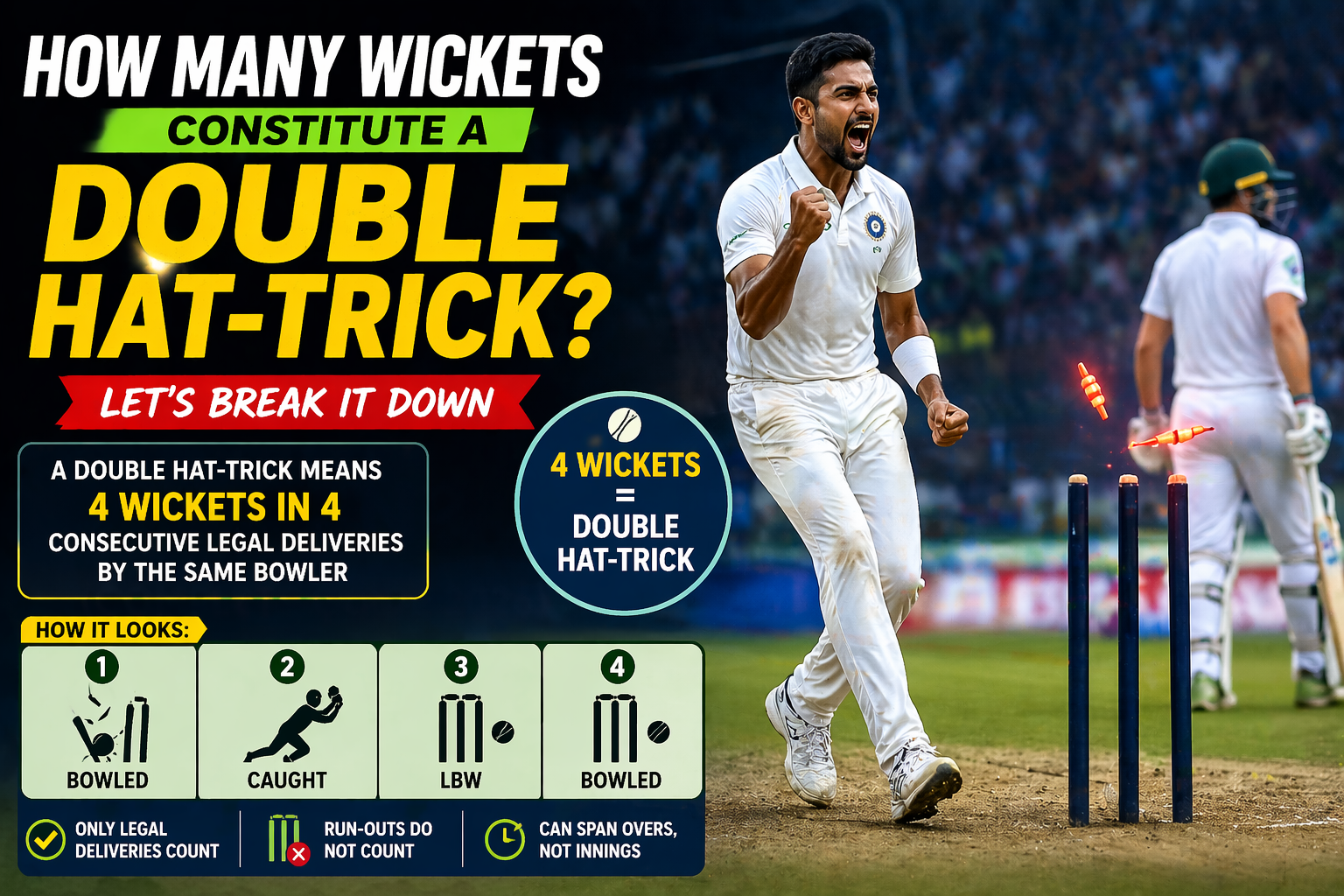
4 wickets in 4 consecutive legal deliveries by the same bowler
In simple words, a bowler needs to dismiss four batters in a row without any interruptions like wides or no-balls.
Hat-Trick vs Double Hat-Trick (What’s the Difference?)
To really understand how many wickets constitute a double hat-trick?, it helps to compare it with something more familiar.
- A hat-trick = 3 wickets in 3 balls
- A double hat-trick = 4 wickets in 4 balls
That one extra wicket might not sound like a big deal, but in cricket, it’s incredibly tough to pull off.
What Does It Look Like in a Match?
Let’s imagine a real scenario so you can clearly picture how many wickets constitute a double hat-trick?:
- Ball 1: Bowled
- Ball 2: Caught
- Ball 3: LBW
- Ball 4: Bowled
Just like that—four balls, four wickets. And the game can completely flip in those few seconds.
What Counts… and What Doesn’t?
This is where people often get confused while figuring out how many wickets constitute a double hat-trick?.
Here’s the simple rule:
These count:
- Bowled
- LBW
- Caught
- Stumped
- Hit wicket
These don’t count:
- Run-outs (because the bowler doesn’t get the credit)
- Wides or no-balls (they break the streak)
Can It Happen Across Overs?
Good question—and yes, it can.
If you’re still thinking about how many wickets constitute a double hat-trick?, remember this:
- It can stretch across two overs
- But it can’t continue into a new innings
So if a bowler takes 2 wickets at the end of one over and 2 at the start of the next—it still counts.
Why Is It So Rare?
Even after knowing how many wickets constitute a double hat-trick?, you might wonder why we don’t see it often.
Well, think about it:
- Taking one wicket is already challenging
- Taking four in a row? That’s next-level
- Batters, pressure, pitch conditions—everything has to align perfectly
That’s why only a handful of players have ever done it in international cricket.
Real Players Who’ve Done It
A few bowlers have actually answered the question how many wickets constitute a double hat-trick? with their performances:
- Lasith Malinga
- Rashid Khan
- Curtis Campher
- Andre Russell
Each of these moments completely changed the game in just a few deliveries.
Common Myths (Let’s Clear Them Up)
There’s a lot of confusion around how many wickets constitute a double hat-trick?, so let’s quickly fix that:
- It doesn’t mean 6 wickets
- Run-outs are not included
- It doesn’t have to happen in a single over
Final Thoughts
So next time you hear someone ask how many wickets constitute a double hat-trick?, you’ll know exactly what to say: it’s 4 wickets in 4 consecutive legal balls.
It’s rare, it’s exciting, and when it happens, it can turn a match on its head in seconds. Now that you understand how many wickets constitute a double hat-trick?, you’ll probably enjoy those moments even more when they happen.
FAQs
Q1. How many wickets constitute a double hat-trick?
It’s 4 wickets in 4 consecutive legal deliveries.
Q2. Is it an official cricket rule?
Not officially—it’s more of a popular cricket term.
Q3. Can it happen across overs?
Yes, but not across innings.
Q4. Do run-outs count?
No, they don’t count in the sequence.


