
These days, cricket has a rule everyone knows: six balls make an over. Simple enough.
But that wasn’t always how things worked. In cricket’s earlier days, the number of balls in an over was… honestly, kind of all over the place. Different countries had different rules, and even within the same country those rules changed over time.
So, how many balls were originally there in one Test over?
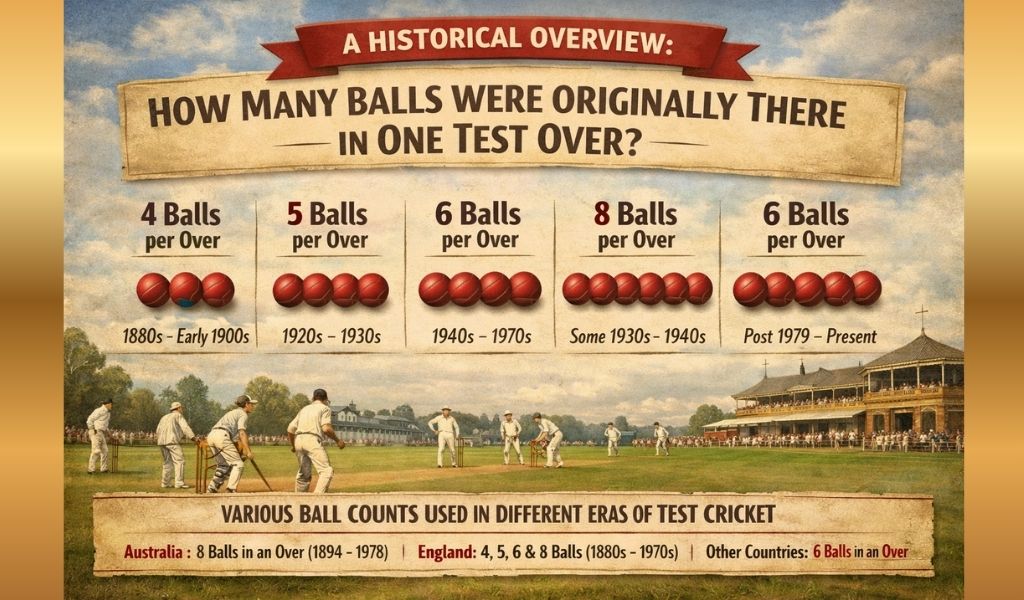
The short answer is: there wasn’t one original number. Depending on the place and the period, an over could be 4, 5, 6, or even 8 balls.
Eventually, as international cricket became more structured and standardized, the sport settled on the six-ball over we know today.
Here’s how that shift happened across the major cricketing nations.
England: The Birthplace of Change
Even in England—the home of cricket—there wasn’t a fixed format for overs for quite a while.
- Before 1889: 4-ball overs
- 1889–1899: 5-ball overs
- 1900–1938: Mostly 6-ball overs
Notable exceptions:
- Surrey vs London County (1900) — 5 balls
- MCC vs Nottinghamshire (1900) — 5 balls
Oddly enough, approval for six-ball overs came after one of those matches had already started. Cricket governance was a bit messy back then.
- 1939: Brief move to 8-ball overs
- From 1945 onward: Permanently 6 balls
So yes—even where cricket began, the over wasn’t set in stone for decades.
Australia: A Long Experiment with 8-Ball Overs
Australia probably had one of the most complicated over histories anywhere.
- 1850/51–1886/87: Mostly 4-ball overs
Exceptions (6 balls):
- Victoria vs Tasmania (1870/71)
- Tasmania vs Victoria (1872/73)
- South Australia vs Tasmania (1877/78)
- South Australia vs Victoria (1883/84)
- Late 1880s: A mix of 4 and 6-ball overs—sometimes in the same season
- 1889/90–1914/15: Mostly 6-ball overs
Exceptions (5 balls):
- NSW vs Sheffield XI (1891/92)
- Victoria vs Tasmania (1898/99)
- 1918/19–1978/79: Mostly 8-ball overs
- Though some international matches still stuck with 6
- From 1979/80 onward: Standardized to 6 balls
Australia’s long relationship with the 8-ball over is a big reason this whole topic gets confusing fast.
South Africa: Gradual Standardization
South Africa moved through several formats before settling down.
- 1888/89: 4 balls
- 1889/90–1898/99: 5 balls
- 1902/03–1936/37: Mostly 6 balls
Exception:
- One match in 1936/37 used 8 balls
- 1937/38–1957/58: 8-ball overs
- From 1958/59 onward: 6 balls
India: A Blend of Global Influence and Local Experimentation
India’s cricket setup followed global trends in some periods, but also experimented here and there.
- 1889/90–1899/1900: 5-ball overs
- 1900/01–1945/46: 6-ball overs
- 1946/47 & 1947/48: Mostly 6 balls
Exceptions:
- Certain tournaments and individual matches used 8-ball overs
- 1948/49–1960/61: 6 balls
- Early 1960s: Occasional 8-ball overs in domestic cricket
- 1962/63: Full switch to 8 balls
- From 1963/64 onward: Permanent return to 6 balls
A bit of experimentation, then back to normal.
New Zealand: Frequent Switching
New Zealand changed formats more often than most.
- 1859/60–1894/95: No fixed standard
- 1895/96 onward: Mostly 6 balls
Exceptions:
- Some isolated 5 or 8-ball overs
- 1918/19–1926/27: 8 balls
- 1927/28–1936/37: 6 balls
- 1937/38–1943/44: 8 balls
- 1944/45–1966/67: 6 balls
- 1968/69–1978/79: 8 balls
- From 1979/80 onward: 6 balls
Safe to say New Zealand liked to keep everyone guessing.
West Indies and North America
West Indies
- 1860s–1900: Mainly 5-ball overs
Exceptions:
- Some matches used 4 or 6 balls
- 1900/01–1937/38: 6 balls
- Late 1930s–1940s: Many 8-ball overs
Exceptions:
- Some matches remained at 6 balls
- From early 1950s onward: 6 balls
North America (USA, Canada, Bermuda)
- Late 1800s: Mixed formats—4, 5, and 6-ball overs
- 1897–1913: Mostly 6 balls
- 1951: Short-lived use of 8-ball overs
- From 1972 onward: Standard 6 balls
Other Cricketing Nations
Some nations more or less adopted six-ball overs from the start.
- Argentina
- Bangladesh
- Kenya
- Malaysia
- Namibia
- Nepal
- Netherlands
- United Arab Emirates
- Zimbabwe
Pakistan
- 1947/48–1972/73: 6 balls
- 1973/74–1978/79: Mostly 8 balls
- From 1979/80 onward: 6 balls
Sri Lanka (Ceylon)
- 1925/26–1974/75: 6 balls
- Mid-1970s: Brief trial with 8-ball overs
- From 1978/79 onward: 6 balls
Conclusion: So, How Many Balls Were Originally There in One Test Over?
If cricket history tells us anything, it’s this:
There was never one “original” number of balls in an over.
Depending on where—and when—you were watching, an over could contain:
- 4 balls
- 5 balls
- 6 balls
- 8 balls
As international cricket became more organized, consistency started to matter more. Slowly but surely, the six-ball over became the worldwide standard. By the late 20th century, it had been adopted across Test and first-class cricket everywhere.
What started as a flexible, sometimes chaotic rule turned into one of the sport’s core structures—helping shape cricket’s rhythm, tactics, and the way the modern game is played.


